The Door Is a Mirror: Notes From the Wrong Side of the Rope
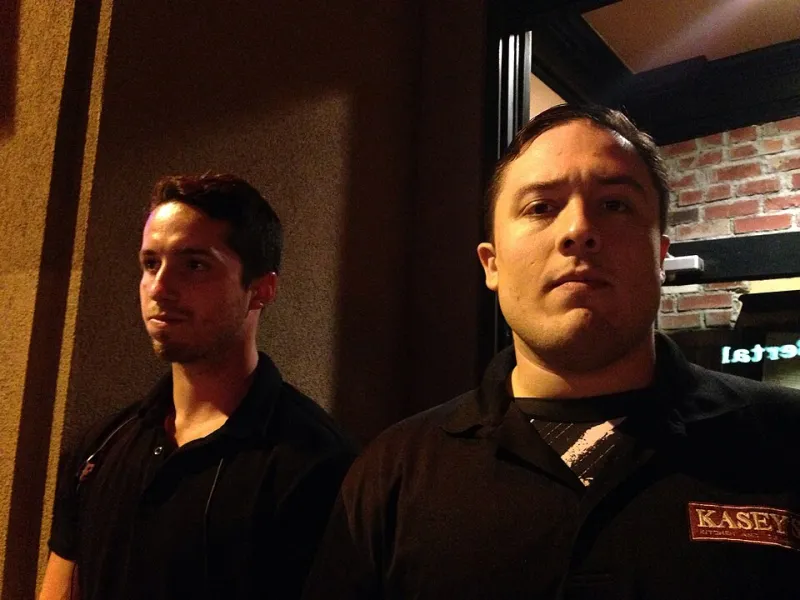
Photo: Xxinvictus34535, CC BY-SA 4.0, via Wikimedia Commons
At 00:47 on a Saturday in Leeds, the city centre stops pretending to be a set of streets and becomes a set of decisions. Who walks in a straight line. Who is holding someone else’s coat. Who has already lost the argument they are about to have. From the door, you see it all in silhouette: the night as a series of small negotiations, most of them unspoken.
In 2026, the UK night out is still sold as spontaneity — a last-minute plan, a group chat, a taxi that costs more than the drinks. But the door knows better. By midnight, spontaneity has a shape. It has a queue, a dress code, a closing time and a bouncer with a torch. The job is not to ruin the fun. The job is to notice what the fun is made of.
The queue is a quiet exam
A queue is not a queue. It is a syllabus. You can learn a lot about a group from the way it arranges itself: the organiser at the front, the diplomat in the middle, the one who has already wandered off. There is the late joiner who swears they were always here. The couple who split up to double their chances. The lad who tries to shake hands with the door and call it networking. The hen party that has decided the pavement is a stage.
Queue etiquette is the invisible social contract in its purest form. People audition for a room they have not seen yet. They perform patience, cool, generosity, indifference. The door reads posture, eye contact, the way a group closes ranks. It is not about being nice. It is about being legible. A good door person is not a judge of character; they are a reader of situations. And the situation is usually this: a lot of people want to be inside, and only some of them understand that inside is a shared space, not a prize.
Dress code is not about clothes
Trainers or no trainers. Shirts or no shirts. Heels on cobbles, lanyards on a Friday, fancy dress in February. Dress code is rarely about fabric. It is shorthand for a question: do you understand the room you are asking to enter?
That is why the same outfit can sail through one door and stall at another. A black shirt is not a moral position. A pair of clean trainers is not a confession. But dress code is a low-resolution filter for risk, effort and vibe, and everybody knows it. The door is not checking whether you can afford the clothes. It is checking whether you have read the brief.
This is the quietly provocative part: the dress code is a class border with better lighting. It pretends to be about style and often works as a test of cultural fluency. The people who pass are not always the best dressed. They are the ones who look like they already belong. The door can see the difference between confidence and costume, and it can see when someone has been told the rules by a friend in the taxi.
The 2AM choreography
Closing time is not an ending. It is a second opening. The lights come up, the music becomes a rumour, and the pavement turns into a stage for the oldest show in the city: who leaves with whom, who leaves alone, who leaves it too late to leave gracefully.
You watch the choreography. The group that leaves early because someone has work in the morning. The group that leaves late because someone has something to prove. The couple who argue by the taxi rank and then get into the same car. The friend who holds the phone torch above a lost purse like a tiny searchlight. The kebab shop queue, which is its own democracy. The bouncer from the next venue who nods at the bouncer from this one, a small diplomatic exchange between neighbouring states.
The invisible social contract of the night is not written down, but everyone signs it. We agree to be managed for a few hours so we can pretend we are not. We agree to queue, to show ID, to take the no, to move along. In return, we get a room where the rules are clear and the consequences are someone else’s problem until 3AM.
What the door actually protects
It is not the carpet. It is not the owner’s licence, though that matters. The door protects the mood. A venue is a fragile ecosystem: the wrong energy at the entrance can curdle the whole room. The door’s eye is not moral. It is architectural. It is looking for load-bearing people and loose connections, for the group that will hold together and the one that will fall apart by last orders.
That is why the best door staff are rarely the loudest. They are the ones who notice the quiet change in a group’s posture, the second attempt to argue, the person who has had enough but does not know it yet. They are translators between the street and the room. The job is not to judge. The job is to notice, and then to decide what the night can safely hold.
The morning after
At 3:20, the city is honest. The queue is gone. The lights are unflattering. The pavement is a museum of small decisions: a lost chip, a flyer, a single shoe that no one will claim. The door person sees the night at its most undressed, and then goes home.
If you want to know what Britain is like after dark, don’t ask the DJ. Ask the person who decides who comes in. The door is a mirror. You are the one watching.