No One Is Getting Off Here: Britain’s 3AM Bus Confessional
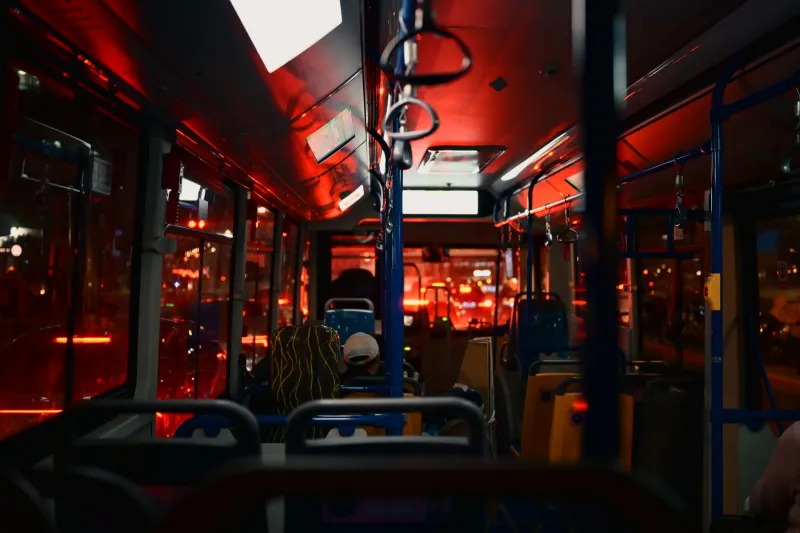
At 3:12am on a Friday in 2026, the upper deck of a southbound night bus out of central London is doing what it always does: pretending not to be a room. Fluorescent light, blue-grey seats, a window fogged by breath and weather. Someone is asleep against the glass. Someone is eating chips with the careful dignity of a person who has not eaten since lunch. Someone is talking, quietly, to a stranger. This is not travel. It is a rolling waiting room for people who have run out of other places to be.
The night bus is Britain’s most honest confessional because nobody is trying to be seen. The lighting is bad. The audience is temporary. The exits are frequent. You can say too much on a night bus and still get off at the next stop with your anonymity intact. That is the deal. The vehicle moves; the confession does not have to follow you home.
The Code of the Upper Deck
There is an etiquette to the upper deck, and it is stricter than any members’ club. Front seats are for watchers. Middle seats are for sleepers. Back seats are for people who want to be left alone but would also, if pressed, admit that they would not mind being noticed. Headphones are a door. A coat on the adjacent seat is a wall. Eye contact is a negotiation nobody wants to open.
And yet the code bends. Not often, but at 3AM it bends. The person who asks if you are all right is rarely making conversation. They are checking. The person who tells you about their breakup, their shift, their mother, their missed connection, is not really telling you. They are telling the window, the hum of the engine, the fact that the bus is moving and no one is going anywhere fast.
In London, the N-prefixed routes carry this particular silence up and down the city. In Manchester, it settles somewhere between Piccadilly Gardens and the outer stops, hoods up, headphones in. In Glasgow, it travels down Sauchiehall Street and out into the quiet, where the chatter is warmer and the weather makes the windows sweat. Different accents, same scene. A stranger says something real. The bus keeps going.
The Driver as Accidental Therapist
The driver sees less and hears more. There is a perspex screen, a mirror, a timetable, a route. But there is also the moment when a passenger stands too long at the front, asks a question about the route, and then answers a question nobody asked. The driver becomes an accidental therapist with a gearbox. They cannot fix anything. They can say 'mind the step' and 'you all right, love' and 'this one stops at the lights'. Sometimes that is enough.
Night drivers are not paid to absorb the city’s sorrows, but they do. They hear the same stories in different order: the job that ended, the flat that fell through, the night out that turned into a night awake. They are not counsellors. They are not crisis lines. They are people in a cab at 3AM, keeping a room moving so that other people can keep moving too. The partition is not a barrier. It is a confessional grille with a timetable attached.
A Room With a Hiss
The night bus exists for the people the daytime city forgets to plan for: shift workers, cleaners, kitchen staff, clubbers, early starters, the recently dumped, the recently employed, the people who missed the last train and decided to make a night of it. It is not glamorous. It smells of disinfectant and rain. The heating is either absent or aggressive. The seats are not designed for confessions.
That is precisely why it works. A confessional with better upholstery would be too much. The night bus offers intimacy without atmosphere, which is to say it offers the truth without the lighting. You do not have to look at the person you are talking to. You do not have to know their name. You do not have to see them again. The doors hiss open. Cold air enters. Someone leaves. The room resets.
The Stop Is the Point
Then the bell rings. Someone stands. The bus slows. The conversation ends mid-sentence, because that is how night bus conversations end. No summary, no resolution, no exchange of numbers. Just a nod, a step, a hiss of doors. The person who said too much disappears into a street that will not remember them. The person who listened stays on board, slightly changed, slightly tired.
In 2026, Britain’s nightlife is loud about itself. The night bus is not. It is infrastructure for the after-dark, and it runs on a simple understanding: people need a room that moves when they cannot face a room that stays still. It is not a solution. It is a seat. Sometimes that is the most honest thing a city can offer.
No one is getting off here. Not yet. The bus moves on.