The Lift Goes Up, the Volume Goes Down
At four in the morning, a city stops pretending. The kebab shops are cashing up, the last buses have gone to bed, and the taxi ranks have thinned to a few patient engines. The multi-storey car park is still open. It is not a venue. It is not a viewpoint, exactly. But it is a room. And in a country that closes early and charges for everything, a room with no bouncer and no last orders is a rare kind of mercy.
The ramp is the nave
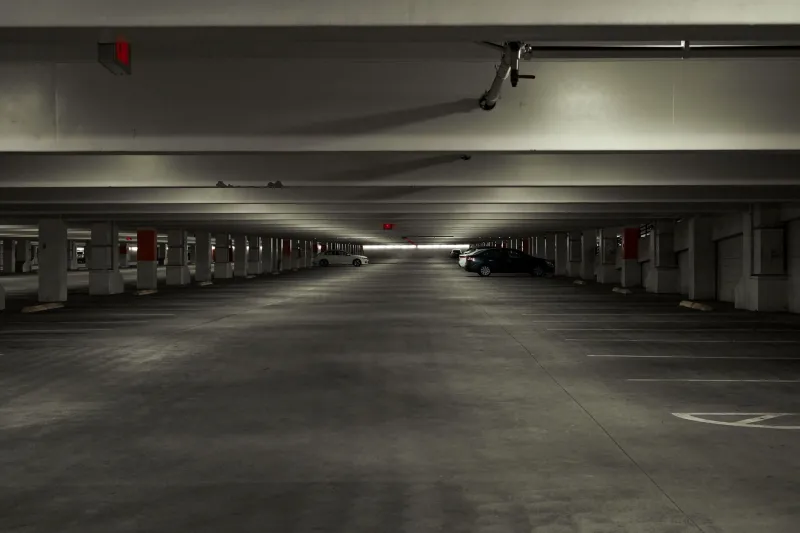
You enter through a barrier that reads your number plate and asks no questions. The ramp curls upward in painted arrows and stained concrete, each level a little quieter than the last. Level two still has the street in it: bins, shutters, a bus sighing past. Level four smells of wet concrete and old exhaust. By level six, the city is a rumour. You can hear it, but you cannot quite touch it.
The top deck is the point. Open sky, fluorescent strips, a grid of empty bays. Wind moves through the stairwell and makes a sound like someone breathing nearby. The payment machine glows. The lift hums. The cameras blink their red dots. Nobody is here to shop. Nobody is here to eat. They are here because the car has become a room and the room has become a place to think without being seen.
The etiquette of not being seen
There is a code on the top deck, and nobody wrote it down. You do not park next to the only other car. You leave a bay, maybe two. You kill the headlights but not always the engine. You do not stare. You do not knock. If you pass someone on the stairs, you nod at the floor. The nod says: I am not here, you are not here, we are both doing fine.
You see the same people in different shapes. A taxi driver eating a sandwich with the radio low. A delivery rider warming his hands. A nurse in scrubs sitting in a hatchback with the seat back and the phone face-down. A couple not talking. A man in a suit with his tie loosened, staring at the windscreen as if it might explain something. None of them are characters in a crime story. They are just people who needed a room that was not their kitchen, not their office, not the inside of their own head for one more hour.
The engine-idlers are part of the furniture. Some are charging phones. Some are keeping warm. Some are waiting for a call that will not come until morning. The car park does not judge the idling. It was built for cars, after all. The people are the afterthought.
What people bring up there
The top deck holds a lot of conversations that never happen. You can see them forming in cars: the phone picked up, put down, picked up again. The message typed and deleted. The argument that stays behind closed doors and closed windows. The apology rehearsed to a steering wheel. Britain is good at keeping a stiff upper lip, but a car park at 4am is where the lip wobbles quietly and then straightens itself out before anyone notices.
It is also one of the last places you can sit without buying anything. Not everywhere, of course. Some car parks charge by the hour, and the barrier is a small act of violence at the end of the night. But many go free after a certain hour, or cost less than a coffee. That matters. A café asks you to consume. A pub asks you to belong. A multi-storey asks only that you do not block the ramp.
People bring grief up there. They bring job worries and housing worries and the low-grade dread of a Monday that starts on Sunday night. They bring the strange relief of being anonymous in a place that is technically public and practically private. Nobody knows your name on level six. Nobody asks how you are. It is not unfriendly. It is simply uninterested, and sometimes that is the kindest thing a city can offer.
The stairwell has different acoustics
The stairwell is the confessional booth. Every footstep doubles. A cough becomes a statement. If someone sings a line of a song, it hangs in the air longer than it should. The lift is worse: a moving metal box with mirrors and a smell of disinfectant, where you stand too close to a stranger and both pretend to read the floor numbers.
On the top deck, sound is flat. The wind takes it. A car door closes and the noise disappears into the open air. Below, the city is a low wash of sirens and refrigeration units and distant trains. Up here, you can hear a can roll across the concrete for what feels like ten seconds. You can hear your own thoughts arrive.
The leaving
Just before sunrise, the car park changes hands. The night people leave and the day people arrive. A cleaning machine groans around the corners. A van with its headlights on waits for a space. The sky goes grey, then a pale, apologetic blue. The barrier lifts. The spell breaks.
You drive down the ramp with the window open and the radio on, and the city comes back in pieces: the bakery, the bus stop, the man stacking newspapers outside the shop. You feel as if you have been somewhere, even though you have only been six floors up. Level six is not a chapel, not really. But it is close enough for a country that does not like to talk about what it needs. It is a concrete room with a view of nothing much, and it is always there. That is the point.