Unit 214 Is Not Asleep: Notes From Britain’s 3AM Self-Storage Corridors
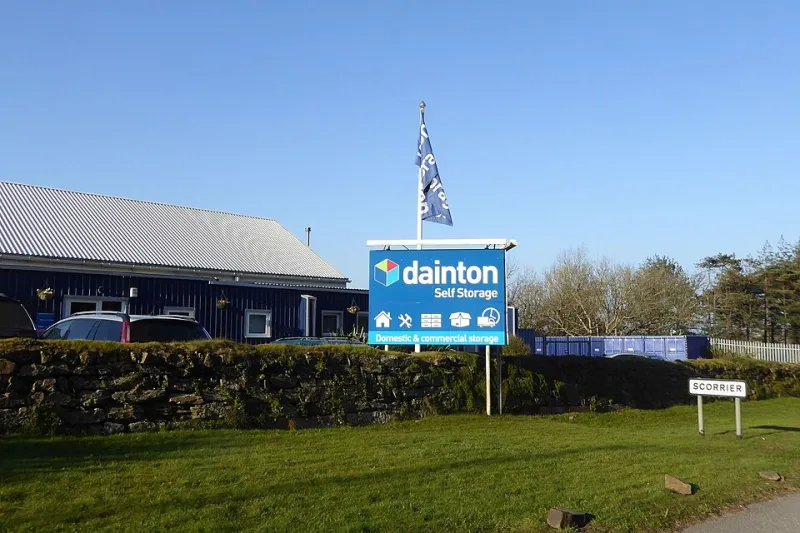
Photo: David Smith , CC BY-SA 2.0, via Wikimedia Commons
The retail park is empty at 3am. The DIY store is a dark slab. The tyre place has gone quiet. The only lit thing is the self-storage facility, standing there like a fridge door left open in a field. You press the keypad. It beeps. The door clicks. Nobody asks why you’re here.
This is not nightlife, exactly. There’s no music, no queue, no bouncer with a clipboard. But it is an after-dark venue all the same — part lock-up, part sanctuary, part archive of unfinished lives. People come here at odd hours to move things they can’t move in daylight. Not always because it’s illegal. Usually because daylight has witnesses.
The keypad is the bouncer
Every self-storage facility has the same threshold: a keypad, a fob, a code you’ve had to remember or write on your hand. The entrance lobby smells of carpet tiles, cardboard and the faint metallic tang of the lift. There’s a noticeboard with fire safety instructions and a laminated sheet about trolley returns. Nobody reads it. The lift doors open with a soft thud.
At 3am the lobby is a waiting room for people who are not waiting for anything. A man in a hoodie stands with a flat-pack wardrobe balanced on a trolley. A woman carries a bin bag that clinks. Someone else has a lamp with no shade. They do not make eye contact. They are all here for the same reason: to put something away, or take something out, without having to explain it.
What gets moved after midnight
The obvious answer is furniture. Beds from relationships that ended. Desks from jobs that vanished. Gym equipment bought in January and stored by March. But the units hold stranger things too. A surfboard in Coventry. A box of school reports. A late parent’s china wrapped in tea towels. A drum kit that belongs to a band that no longer practises. Business stock for a shop that never opened. The contents of a flat that someone is not ready to sort through.
Self-storage is not a secret. It is a deferral. You put something in a unit because you cannot yet decide what it means. The unit is a promise: I will deal with this later. Later is a flexible word. It can stretch for years.
The corridor is a confessional
The corridors are narrow and bright. The lights never flicker. The floor is grey and clean. Roller doors line the walls like closed mouths. You hear everything: trolley wheels, a box being dragged, the clatter of a padlock, someone saying ‘it’s just until I find a place’ into a phone. The acoustics are honest. There is no soft furnishing to absorb the truth.
At 3am, people talk to themselves in self-storage. They mutter inventories. They say ‘right’ and ‘okay’ and ‘fine’ as if the unit might answer back. Sometimes two strangers share a lift and have the most honest conversation they’ve had all week. Not because they know each other, but because they never will. The lift is a small neutral country. You can say anything for forty seconds and then the doors open and you go your separate ways.
A short history of keeping things
The UK’s self-storage habit is relatively recent. The big branded facilities started spreading across our retail parks in the 1980s and 1990s, turning old warehouses into corridors of identical doors. Since then, the industry has become a quiet fixture of British life — somewhere between a garage, a loft and a therapist’s waiting room. We are a nation that likes to keep things. We are also a nation that likes to postpone decisions. Self-storage is where those two habits meet.
The roller door remembers
There is a particular sound a roller door makes when it closes. It’s not a slam. It’s a long, mechanical sigh. It sounds like something being put to bed. The door does not judge what’s inside. It does not care if the boxes are labelled or if the contents make sense. It just rolls down and locks.
At 3am, that sound is everywhere. It is the sound of people closing a chapter they are not ready to finish. The unit holds the evidence: the old photos, the spare duvet, the files from a company that went under, the wedding presents from a marriage that didn’t last. The roller door remembers, in the way that all quiet things remember. It keeps the shape of what was put inside.
Leaving is the strangest part
When you step back out into the car park, the air is cold and the sky is that orange-black colour of a town that never fully switches off. Your car is the only one in the row. You drive home past the closed shops and the sleeping houses. You have not done anything dramatic. You have just moved a box from one place to another. But something has shifted. You have visited the version of yourself that lives in Unit 214, and you have left them there, behind a roller door, until next time.
What does Britain keep stored when no one is watching? Not secrets, exactly. More like possibilities. The people we might become if we ever get round to sorting through the boxes. The keypad doesn’t ask why. It just beeps, and lets you in.